
The “Safety” Distraction: When Accountability Is Called “Abuse"
A lawful paper trail is not harassment just because it asks the question nobody wants to answer

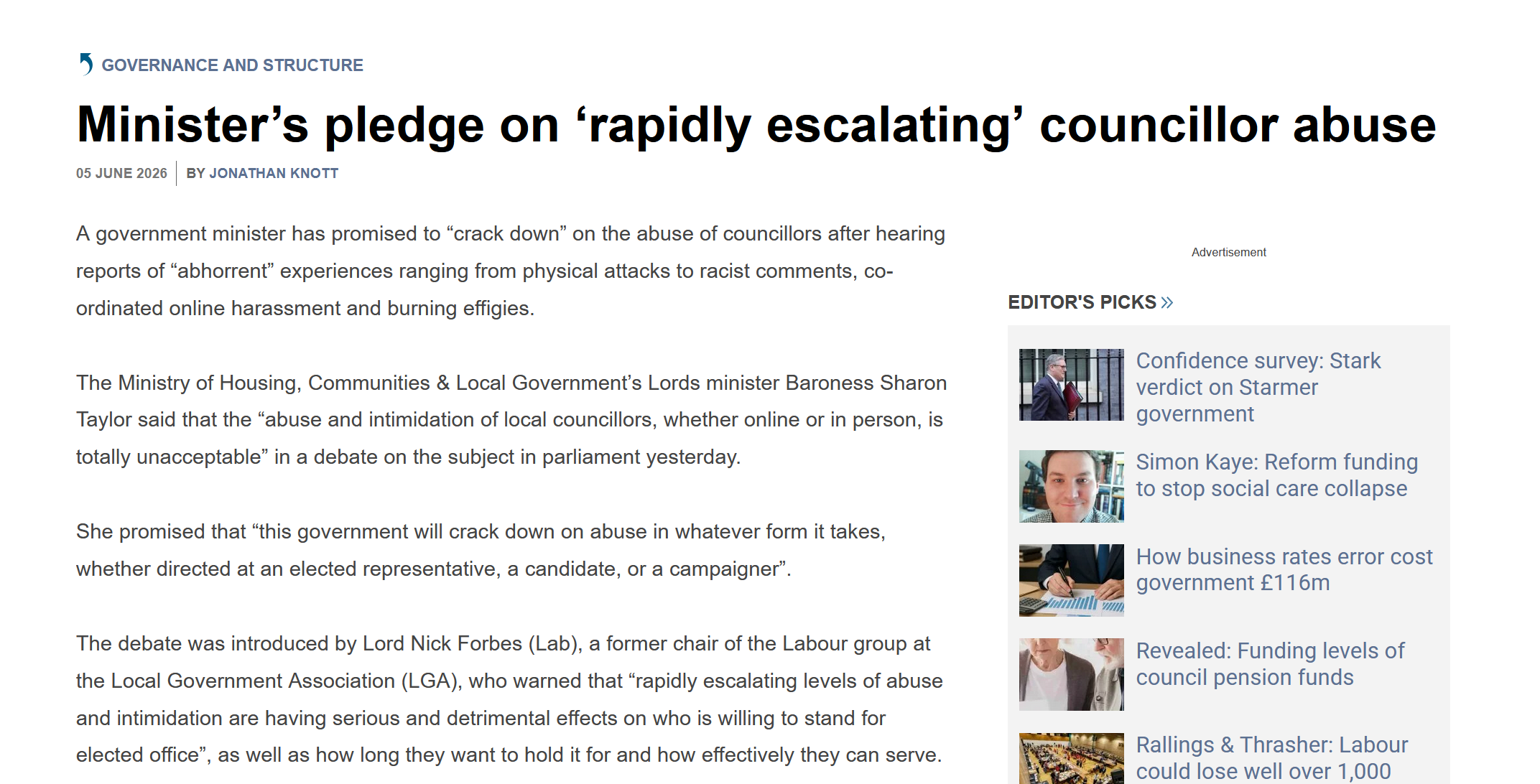
Screenshot source: Local Government Chronicle (LGC), article headline, 5 June 2026. Used for commentary and public-interest analysis
Let us start with the boring but necessary sentence, because apparently adults now need this written down before any public discussion can begin.
Genuine threats, violence, harassment, racism, or intimidation against councillors, officers, candidates, campaigners, or anyone else are wrong. They should be dealt with properly under the law.
There. Said clearly. And now… we may proceed to the interesting part.
What we are watching right now is not simply a noble defence of frightened councillors from a cruel, barbarian public. It is something much more useful to the system: a well-known language shield, arriving at the exact psychological moment residents have started asking questions that cannot be answered. How incredibly convenient.
On 5 June 2026, ministers found time to speak passionately in Parliament about “rapidly escalating councillor abuse.” We were told the Government will “crack down” on abuse “in whatever form it takes.” It was all very moving.
Yet, as many times before, a remarkable coincidence occurred -and we are becoming great collectors of coincidences. This passionate defence arrived at the precise moment the County Councils Network (CCN) wrote to the Prime Minister warning that Local Government Reorganisation (LGR) is running into serious funding, transition, and “safe and legal” service-delivery problems. That letter raises the very same questions residents have been forcing onto the record for months: where is the money, where is the lawful basis, where is the financial analysis, and who exactly is carrying the risk?
But instead of a mature national conversation about unfunded reorganisation, missing statutory authority, and public money already spent before Royal Assent, we are warmly invited to talk about councillor safety instead. Of course we are. It is a very useful subject indeed.
Because nothing changes the atmosphere of a room faster than suggesting that a member of the public asking questions might be “abusive.” The moment that card is played, the ledger clears. Suddenly, the Section 151 Officer does not have to identify the statutory authority. The Monitoring Officer does not have to explain the legal basis. The council does not have to produce the Best Value record, and the expenditure no longer has to be justified. In one slick move, the resident becomes the problem.
How wonderfully concerning and caring. It is almost Soviet in its simplicity.
We have seen this pattern playing out locally already -and more than once.
Take the recent case of a resident attending a Full Council meeting to read out FOI responses. Mind you, these weren’t rumours, gossip, or the dreaded “misinformation.” This was the council’s own data, provided through the proper statutory channels. The questions were legal, the documents were public, and the process was purely democratic.
The response? Not to address the evidence, naturally. Instead, the resident himself was reframed as the problem. His conduct became the issue, his tone became the emergency, and his very presence became a source of “discomfort.”
Then the chairwoman went a step further, declaring that she actually felt offended—as if a resident asking a public official a lawful question is somehow an unacceptable personal assault. Just like that, the question disappeared, and her personal feelings became the shield. The evidence sits there quietly on the table to this day, completely unanswered, while everyone stops to admire the new moral wallpaper.
We saw it again in another area, where residents objected to a planning proposal through the official statutory consultation process. They did exactly what the rules told them they were allowed to do: they submitted objections, in writing, through the correct route, within the correct time frame. The response from the local politician? A councillor publicly described those official objections as “harassment.”
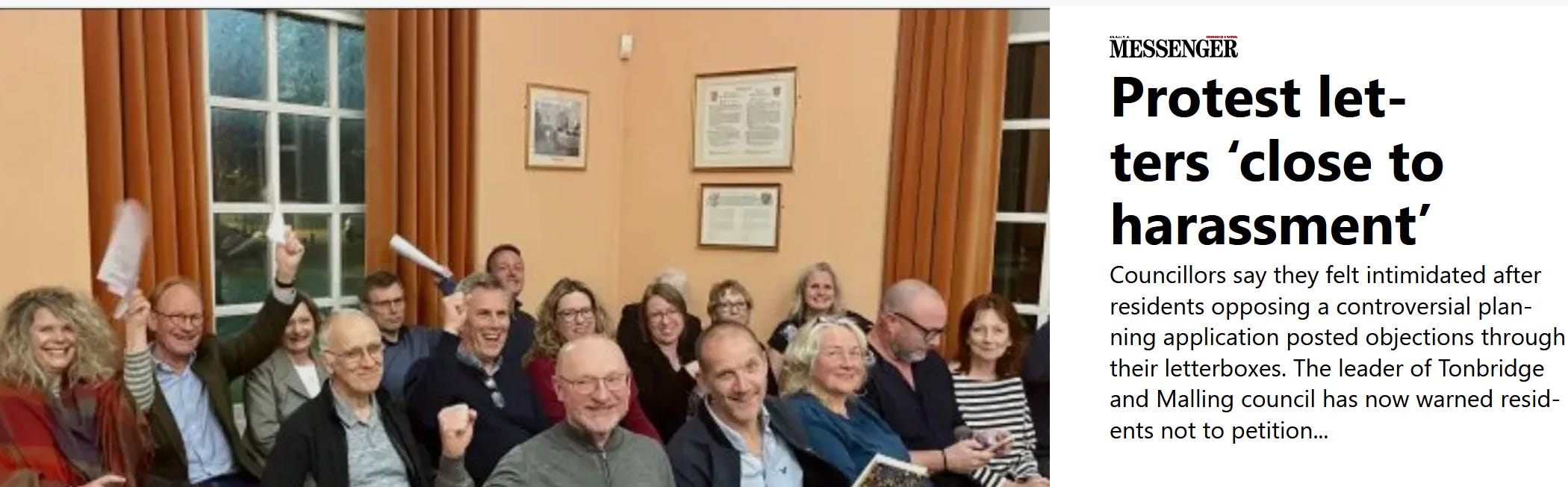
image sources :PressReader
So let us understand the new civics lesson being taught here. The public may participate in consultation, provided they do not object. They may attend meetings, provided they do not ask the wrong questions. They may write to councillors, provided the councillors enjoy the contents. They may use FOI, provided the answers do not embarrass anybody. They may scrutinise public money, provided no public body actually feels scrutinised.
How very democratic….
This is the pattern, and it is worth setting out plainly so everyone can spot it. A lawful question is asked. A formal notice is served. A statutory right is exercised. A public document is quoted. A resident asks: where is the law?
And instead of simply pointing to the law, the system reaches for the smelling salts.
Aggressive. Disrespectful. Harassing. Obsessive. Misinformed. Abusive. The label changes, but the function never does. It is designed entirely to move attention away from the public decision and place it squarely onto the person questioning it.
That is why Lord George Young’s warning in the very same parliamentary debate matters so much. He raised the distinct risk that mechanisms designed to protect councillors from genuine abuse could easily be weaponised to suppress legitimate criticism of elected officials. That is the one sentence from the entire debate worth printing in red ink.
Because there is a massive difference - a very simple one- between abuse and accountability.
Abuse targets people; accountability targets power. Abuse threatens; accountability asks for records. Abuse intimidates; accountability asks for statutory authority. Abuse harasses private life; accountability follows public money. Abuse is personal; accountability is documentary.
And that is precisely why accountability irritates them so much more.
When the National Residents for Civic Accountability (NRCA) serves Pre-Action Protocol letters, we aren’t shouting. We submit FOI requests. We issue formal freeze notices to Section 151 Officers. We ask Monitoring Officers to identify legal authority. We write to councillors about public expenditure, audit, mandate, data governance, and Best Value. We sit quietly in the public gallery and ask lawful questions.
It is all very dull, really. Dates, documents, references, statutes, timelines, and evidence schedules. No pitchforks, no mobs, no threats. Just paperwork. Which is probably exactly why it is causing so much distress.
A shouting crowd can easily be dismissed. A rude email can be blocked. A badly phrased social media comment can be clipped, circulated, and used as proof that the public is dangerous. But a formal legal notice asking a Section 151 Officer to identify the exact statutory authority for pre-Royal-Assent expenditure is far less convenient. It just sits there on the desk. It waits. It asks the same unyielding question tomorrow that it asked yesterday. And when no answer comes, that heavy silence becomes evidence. And of course, the only defensive shield left is to wildly misinterpret actions because why deal with facts when you can dramatise fiction.
That’s the real issue for them. Not the supposed “abuse”. The evidence - the one thing they can’t spin.
The County Councils Network letter to the Prime Minister should be the real headline story this week. Councils themselves are now warning that the LGR transition is not properly funded, that “safe and legal” service delivery is at risk, and that the Government has completely failed to provide the underlying financial analysis.
At the same time, the Ministry (MHCLG) has told the NRCA in writing that central government and local authorities are separate legal entities, and that local spending decisions are matters for local authorities alone, subject to their own statutory duties. In plain English: Whitehall has no intention of putting its own coat over the muddy puddle for local officers .
So now, every individual council must answer for itself. What statutory authority was relied upon? What Best Value assessment was completed? What audit trail exists? What financial revalidation was carried out? What data-sharing records were created? What lawful authority existed before Royal Assent?
These are not abusive questions. They are the foundational questions that should have been answered before a single penny of public money was spent.
But if those questions cannot be answered, the temptation to change the subject must be absolutely enormous. And right on cue, here comes the perfect substitute: Safety. A word no decent person wants to dismiss. A word that can be used to gather genuine victims, political discomfort, unpleasant public criticism, lawful scrutiny, angry residents, internet trolls, FOI users, planning objectors, and constitutional challengers into one convenient, muddy moral fog.
Nobody wants abuse. Nobody defends threats. Nobody wants councillors feeling frightened in their homes. But that is precisely why the category must not be abused itself.
If a resident threatens a councillor, deal with it. If a resident harasses a councillor’s family, deal with it. If a resident uses racist abuse, prosecute them. But if a resident sends a lawful notice asking for the statutory authority behind public expenditure—answer it. The difference is not difficult, unless someone desperately needs it to become difficult.
And that is exactly where we stand today.
The very people who tell us they are protecting democracy are simultaneously reorganising local government without a genuine public mandate, shifting planning powers upward, centralising strategic control, and spending public money before a lawful basis is even identified - and then becoming terribly sensitive and offended when residents ask them to show the paperwork.
It would be funny if it were not so serious. Actually, it is still funny. In a dark way.
The public is apparently mature enough to pay for the entire programme, live under the new structures, lose their local representation, absorb the planning consequences, fund the high-priced consultants, carry the resulting debt, and be told there is no alternative. But the moment they ask to see the law, they are suddenly treated as a safeguarding concern.
Bless…..
Well .. we can promise : The NRCA will not abuse councillors. We will not threaten officers. We will not personalise public duties. We have no intention of giving them the easy excuse they are so plainly waiting for.
Instead, we will do something “ much worse”
We will continue to be entirely lawful. We will continue to be surgically precise. We will continue to ask for the statutory authority. We will continue to record the replies, and we will absolutely continue to record the silences.
Because accountability is not abuse. It is just what public bodies call abuse when it finally starts working.
And if the new definition of “abuse” now officially includes residents asking public officials to identify the law behind public expenditure, then the English language has travelled a very long way indeed…..We shall, naturally, record the journey.
National Residents for Civic Accountability residentsconcern@proton.me Supporting Pre-Action Protocol challenge NRCA/PAP/SCO/2026/001
My experience of being abused by councillors
Report: Council Co-option Meeting – 7 April
Peter Nicholson
To: me · Wed, 15 Apr at 21:56
Message Body
Report: Council Co-option Meeting – 7 April
I attended the Town Hall as a candidate for co-option to the Council. What followed was not a fair or orderly process, but a clear abandonment of duty by those entrusted with public office.
My application was physically thrown to the floor in front of those present. Councillor Doug Rathbone then attempted to prevent me from distributing copies to the voting councillors, making repeated efforts to snatch them from my hand. This was not procedure—it was obstruction. The nature of that conduct, in a public setting and directed at a candidate, should reasonably be regarded as bullying behaviour.
When I began my candidate speech, I was met with repeated, unwarranted interruptions.
The Mayor then called for the meeting to be disbanded, and every councillor and officer complied without question—leaving me alone in the chamber, mid-process, as the candidate under consideration.
At that moment, those present did not merely adjourn proceedings—they abandoned their civic responsibilities. In doing so, they denied the process its integrity and failed in their duty to conduct Council business lawfully and transparently.
I raised a clear point of order: Section 2.8 of the adopted Co-option Procedure had not been followed. Instead of addressing that, an uninformed police officer approached me while I remained seated at the candidate table and instructed me to stop speaking. This intervention appeared to fall outside the officer’s proper role and jurisdiction within a civic meeting of this nature, and could reasonably be perceived as both unlawful interference and an act of intimidation. In that context, it may also be viewed as bullying behaviour.
I also perceived this sequence of events as a deliberate attempt to preserve the Council’s Liberal majority rather than to allow a fair and open co-option process.
This conduct has brought the Council into disrepute. It reflects not governance, but avoidance—where procedure is set aside when it becomes inconvenient.
The treatment I received appears rooted not in rules, but in the fact I stood as an independent candidate rather than aligning with the prevailing group.
I had witnesses present who observed the conduct in full.
What should have been a lawful and open democratic process instead became a display of disorder, obstruction, intimidation, and abandonment of office. That is unacceptable in any public body, and it demands accountability.
Peter Nicholson
Office of the Kendal Cultural Attaché
Very well said...